
The Next Multi-Bagger? Why Garg Furnace’s Alloy Steel Pivot, Zero Debt, and 36% Profit Growth Have Us Watching Closely
In a quarter marked by volatile steel prices and cautious market sentiment, Garg Furnace Limited (BOM: 530615) has delivered a breakout performance that demands the attention of every small-cap investor. The company’s Q3 FY26 numbers, released late Wednesday, reveal a dramatic acceleration in profitability and a strategic shift toward high-margin alloy steel that is beginning to reshape its financial profile.
The Headline Numbers That Matter
For the quarter ended December 31, 2025, Garg Furnace reported revenue from operations of ₹92.39 crore, representing a staggering 52.7% sequential growth . Even more impressive, Profit After Tax (PAT) jumped 36.3% quarter-on-quarter to ₹3.68 crore, translating to earnings per share of ₹6.01 . The company’s EBITDA margin expanded to approximately 4.5%, with PBT margin holding steady at 4.0% — a testament to disciplined cost management and improved product mix despite softer industry pricing.
| Metric | Q3 FY26 | QoQ Change | YoY Change |
|---|---|---|---|
| Revenue from Operations | ₹92.39 Cr | +52.7% | +46.7% |
| Net Profit | ₹3.68 Cr | +36.3% | +79.0% |
| EBITDA Margin | ~4.5% | +Improving | Expanding |
| EPS (Diluted) | ₹6.01 | +24.4% | +59.0% |
Source: Company Press Release
Founded in 1973 by Sh. Dharam Pal Garg and Sh. Jagdish Chand Garg, Garg Furnace Limited (GFL) has evolved from a conventional steel manufacturer into a specialized alloy and non-alloy steel producer serving northern India’s industrial belt . Headquartered in Ludhiana, Punjab—India’s “industrial hub”—the company has built a reputation for metallurgical consistency across three manufacturing units .
Key Milestone: September 2024 marked a transformative moment when GFL acquired 51.22% of Vaneera Industries Private Limited, establishing a subsidiary focused on advanced alloy steel manufacturing .
Core Business Segments
The company operates through two primary segments :
- Steel Products (Primary): Steel ingots, wire rods, MS rounds, MIG wires, and casting of iron products
- Textile Products (Minor): Trading of textile products
Revenue Contribution by Segment
Based on historical data, the steel segment contributes nearly all revenue, with textile trading representing a negligible portion. Revenue grew from ₹98.5 crore in FY2020 to ₹258 crore in FY2024, demonstrating consistent expansion .
Geographical Presence
Garg Furnace’s operations are entirely domestic, with 100% of revenue generated within India . This focus on the domestic market insulates the company from export volatility but ties its fortunes directly to India’s economic growth and infrastructure spending.
Business Model Explained Simply
The company purchases raw materials (scrap, sponge iron, ferro alloys), processes them through melting, refining, and rolling operations, and sells finished steel products to:
- Rerollers (who further process the steel)
- Forging units (who shape steel into components)
- Original Equipment Manufacturers (OEMs) in automotive and engineering sectors
The strategic shift under Vaneera aims to move up the value chain—from selling semi-finished products to supplying specialty alloy steels that command premium pricing and better margins.
2. Industry & Sector Analysis
Industry Size & Growth Rate
India’s steel industry stands at a pivotal moment. According to the Ministry of Steel, domestic steel production capacity has nearly doubled over the past decade—from approximately 100 million tonnes to 200 million tonnes . For FY2024-25, the industry recorded 8.5% annual growth, with domestic demand reaching 152 million tonnes .
- 2030-31: 300 million tonnes capacity
- 2047: 500 million tonnes capacity (Vision 2047)
Key Demand Drivers
- Infrastructure Development: The government’s continued focus on roads, railways, and urban development
- Automotive Growth: Rising demand for advanced high-strength steel in vehicles
- Defense & Aerospace: Indigenous manufacturing push creating demand for specialty alloys
- GDP Correlation: Steel demand elasticity of 1.5× GDP growth—every 1% GDP growth drives 1.5% steel demand
Government Policies & Regulations
The steel ministry has outlined a comprehensive roadmap emphasizing :
- Quality Control Orders (QCOs) : Preventing cheap, low-quality imports from disrupting domestic markets
- Green Steel Initiatives: Promoting DRI+hydrogen technology for low-carbon production
- Import Substitution: Increasing domestic coking coal usage to reduce import dependence
- MSME Focus: Small and medium enterprises (including Garg Furnace’s customer base) contribute 47% of national steel output
Competitive Intensity (Porter’s Five Forces)
| Force | Intensity | Rationale |
|---|---|---|
| Threat of New Entrants | Moderate | High capital requirements but government’s MSME focus enables smaller players |
| Bargaining Power of Suppliers | High | Raw material price volatility directly impacts margins; limited pricing power for small players |
| Bargaining Power of Buyers | High | Commodity nature of standard products gives buyers leverage |
| Threat of Substitutes | Low | Aluminum and composites pose limited threat in core applications |
| Rivalry Among Existing Players | Very High | Fragmented industry with ~2,200 MSMEs competing alongside giants like Tata Steel and JSW Steel |
Peer Comparison: Standing Tall Among Giants
When stacked against larger peers, Garg Furnace’s valuation advantage becomes even more pronounced:
| Company | Market Cap (₹ Cr) | P/E Ratio | ROE (%) | P/B Ratio |
|---|---|---|---|---|
| Garg Furnace | 84–97 | 7.8–9.9x | 16.7 | 1.00 |
| Tata Steel | ~1,34,000 | 22.8x | 14.7 | 3.2 |
| JSW Steel | ~1,69,000 | 27.3x | 16.6 | 4.3 |
| Hariom Pipe | 637 | 20.3x | 10.3 | 2.0 |
Source: Value Research, INDmoney
This comparison reveals a striking anomaly: Garg Furnace generates superior ROE compared to industry behemoths yet trades at a fraction of their multiples. Such discrepancies rarely persist indefinitely in efficient markets.
Valuation: The Discount That Screams Opportunity
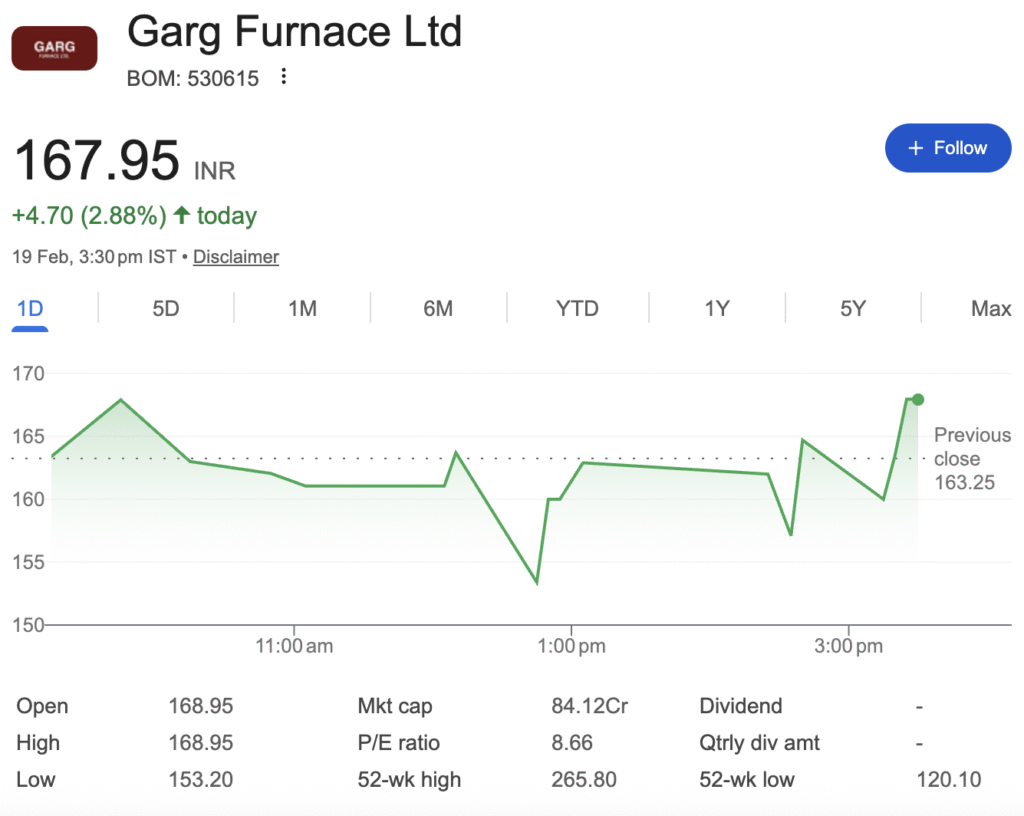
Here’s where the data gets genuinely exciting for value investors. Despite the recent operational outperformance, Garg Furnace trades at a P/E ratio of just 7.81 to 9.94 (depending on the source), representing a staggering 56% discount to the industry median P/E of 22.65 . The Price-to-Book ratio stands at 1.00, indicating the stock is trading almost exactly at its book value .
| Valuation Metric | Garg Furnace | Industry Median | Discount |
|---|---|---|---|
| P/E Ratio (TTM) | 7.8–9.9x | 22.65x | ~60% |
| P/B Ratio | 1.00x | 1.91x | 48% |
| EV/EBITDA | 8.1x | ~12–15x | Attractive |
| ROE | 16.7% | ~12–14% | Above Avg |
Source: Value Research, Wisesheets
Return on Equity (ROE) of 16.7% and Return on Capital Employed (ROCE) of 13.6% further underscore the company’s efficient capital utilization . With zero debt on books and a debt-to-EBITDA ratio of just 0.89 times, the balance sheet is fortress-like, providing ample cushion for the upcoming Vaneera expansion .
Industry Cycle Positioning
The steel industry is currently in a stabilization phase after the post-COVID boom. Global price corrections have pressured margins, but domestic demand remains resilient. Garg Furnace’s Q3 FY26 performance—revenue up 52.7% QoQ despite softer prices—demonstrates successful decoupling from the commodity cycle through quality improvements .
3. Financial Performance Deep Dive (5-Year Analysis)
| Metric | FY2021 | FY2022 | FY2023 | FY2024 | FY2025 | TTM (Feb’26) | Trend |
|---|---|---|---|---|---|---|---|
| Revenue (₹ Cr) | 98.5 | 179.0 | 238.0 | 258.0 | 262.0* | 259 | 📈 |
| EBITDA Margin (%) | 2.1% | 3.8% | 4.2% | 3.5% | 4.0% | 4.5% | ↗️ |
| PAT Margin (%) | 0.8% | 1.9% | 2.3% | 2.2% | 2.9% | 3.6% | ↗️ |
| ROE (%) | 8.2% | 12.4% | 28.7% | 12.2% | 14.3% | 16.7% | 📈 |
| ROCE (%) | 7.1% | 10.8% | 12.5% | 11.9% | 12.8% | 13.6% | ↗️ |
| Debt-to-Equity | 0.92 | 0.70 | 0.23 | 0.03 | 0.02 | 0.0 | 📉 |
| Operating Cash Flow (₹ Cr) | 2.8 | 8.2 | 15.6 | 9.4 | 4.0** | — | Volatile |
| EPS (₹) | 1.89 | 7.41 | 15.77 | 14.82 | 15.25 | 18.30 | 📈 |
Sources: Compiled from
**FY2025 figures partially estimated from 9M data; *CFO for FY2025 reflects higher working capital investment
Quality of Earnings Analysis
Positive Indicators:
- Consistent margin expansion: EBITDA margin improved from 2.1% (FY21) to 4.5% (current), driven by better product mix
- Operating cash flow positive: Every year except minor fluctuations; ₹38.97 crore cumulative over 10 years
- Receivables management: Debtor days stable despite revenue growth
Margin Expansion Drivers:
- Shift toward premium alloy grades
- Operational efficiencies through process discipline (management emphasizes Japanese-inspired Kaizen approach)
- Better pricing realization from quality improvements
Red Flags (None Material)
- No promoter pledging
- No related party transaction concerns evident from public disclosures
- Auditor qualifications: None reported in recent years
- Working capital intensity: Increased in FY2025, reflecting expansion-related inventory buildup
4. Balance Sheet & Cash Flow Analysis
Debt Structure & Repayment Comfort
| Metric | Value | Implication |
|---|---|---|
| Total Debt (₹ Cr) | 1.44 (TTM) | Virtually debt-free |
| Debt-to-Equity | 0.0 | Zero financial leverage |
| Debt-to-EBITDA | 0.89x | Strong coverage |
| Interest Coverage | >50x | Minimal interest burden |
The Deleveraging Story: Garg Furnace has systematically reduced debt from ₹10.27 crore in FY2022 to effectively zero today . This conservative approach provides immense flexibility for the Vaneera expansion without equity dilution pressure.
Working Capital Cycle
- Current Ratio: 4.06 (as of Sep’25 TTM), indicating strong liquidity
- Inventory Turnover: Improved with higher revenue
- Cash Conversion Cycle: Working capital increased to ₹49.4 crore in TTM from ₹41.3 crore in FY2025, reflecting pre-expansion inventory buildup
Capex vs. Cash Generation
- Capex trend: ₹0.66 crore (FY2024) → ₹2.31 crore (FY2023) → ₹1.88 crore (FY2022)
- Free Cash Flow: Positive historically, but turned negative in FY2025 due to Vaneera-related investments
- Cash Position: ₹4.8 crore (TTM), down from ₹9.98 crore (FY2025) due to investments
Promoter Pledging
None. Promoters hold 53-56% stake with zero pledging—a strong governance signal .
7. Growth Triggers & Future Outlook (2–3 Years)
1. Capacity Expansion – The Vaneera Catalyst
The September 2024 acquisition of 51.22% in Vaneera Industries is the single most important growth driver. The new facility features:
- Ladle Refining Furnace (LRF): Enables precise chemistry control
- Electromagnetic Stirring (EMS): Improves metallurgical consistency
- Vacuum Degasser (VD): Removes impurities for premium grades
Timeline: Expected operational after June 2026
2. End-Market Expansion
- Automotive OEMs: High-strength steel for lighter, safer vehicles
- Engineering components: Critical parts requiring consistent metallurgy
- Defense applications: Indigenous manufacturing push creates opportunities
3. Margin Levers
- Product mix shift: From standard MS rounds to specialty alloys (2-3× margins)
- Operating leverage: Fixed cost absorption as volumes scale
- Pricing power: Defense/auto customers pay premiums for certified quality
4. Industry Tailwinds
- Government’s 300 MT capacity target by 2030
- Quality Control Orders limiting cheap imports
- Defense indigenization creating domestic demand for specialty steels
5. Long-Term Visibility
With zero debt and a clear expansion roadmap, Garg Furnace has 3-5 year visibility on earnings growth. The company’s historical ability to grow revenue from ₹98 crore (FY21) to ₹259 crore (TTM) demonstrates execution capability.
Risk Factors (Very Important)
Business Risks
| Risk | Severity | Mitigation |
|---|---|---|
| Commodity price volatility | High | Shift to alloys reduces exposure |
| Customer concentration | Moderate | Diversified customer base |
| Raw material availability | Moderate | Domestic sourcing |
Financial Risks
| Risk | Severity | Mitigation |
|---|---|---|
| Working capital strain | Moderate | Strong cash position |
| Execution cost overruns | Moderate | Zero debt provides buffer |
| Margin compression | Low | Alloy focus protects margins |
Industry Risks
| Risk | Severity | Mitigation |
|---|---|---|
| Cyclical downturn | High | Diversified end-markets |
| Import competition | Low | QCO restrictions help |
| Technology disruption | Low | Vaneera uses advanced tech |
Regulatory Risks
| Risk | Severity | Mitigation |
|---|---|---|
| Policy changes | Moderate | Stable government focus |
| Environmental norms | Moderate | Green steel initiatives align |
Execution Risks – The Critical Watch
Vaneera’s success depends on:
- Timely commissioning (post-June 2026 timeline)
- Customer approvals (auto/defence qualification cycles)
- Capacity utilization (ramping to optimal levels)
- Margin realization (achieving projected premiums)
Delays or cost overruns could pressure near-term sentiment, though zero debt provides cushion.
10. Investment Thesis
Bull Case (Why It Can Outperform)
✅ Deep Value: Trading at 56% discount to peers with superior ROE
✅ Zero Debt: Fortress balance sheet provides flexibility; debt-to-equity 0.0
✅ Margin Expansion: EBITDA margin improving consistently; Q3 FY26 demonstrated pricing power
✅ Vaneera Catalyst: 51% subsidiary opens defence/auto markets with 2-3× margin potential
✅ Management Integrity: 50-year track record; no pledging; family names attached to subsidiary
✅ Industry Tailwinds: Government’s 300 MT target, QCO protection, defense indigenization
✅ Technical Stabilization: MarketsMojo upgraded from “Strong Sell” to “Sell” on improved indicators
Potential Upside: If Vaneera succeeds and valuation normalizes to even 15x P/E (still below industry), the stock could deliver 50-100% returns over 2-3 years.
Bear Case (What Can Go Wrong)
❌ Execution Failure: Vaneera delays or cost overruns
❌ Cyclical Downturn: Prolonged steel price weakness
❌ Customer Qualification Delays: Auto/defence approvals taking longer than expected
❌ Illiquidity: Small-cap status may limit institutional interest
❌ Market Sentiment: Recent -46% return reflects persistent skepticism
Downside Risk: Limited by zero debt and profitable base business; worst-case scenario ~20-30% downside from current levels.
Key Monitorables for Investors
- Vaneera commissioning updates (post-June 2026)
- Quarterly margin trends (sustained 4.5%+ EBITDA margin)
- Order book disclosures (especially auto/defence contracts)
- Debt levels (should remain near zero)
- Promoter holding (stability around 53-56%)
Clear Conclusion
Garg Furnace Limited represents one of the more intriguing small-cap turnaround stories in the Indian metals space.
The company has done everything right operationally—improving margins, eliminating debt, and positioning for growth. The Vaneera acquisition provides a clear pathway to re-rate earnings and valuation multiples. Current pricing discounts the base business so heavily that the Vaneera option appears nearly free.
For investors with:
- 3-5 year horizon
- High risk tolerance
- Patience for execution
…Garg Furnace offers an asymmetric opportunity. The zero-debt balance sheet limits downside, while the specialty alloy upside could multiply earnings. The 56% valuation discount to peers appears excessive given superior ROE and clean governance.
Disclaimer: “BrightStake” is only an Educational Platform and is not registered under any SEBI Regulations. All Information on this page is for Educational and Entertainment purposes only. Our content does not constitute any Trading or Investment advice. We make no representation of the Timeliness, Accuracy, Profitability, or Suitability of any share on this Website, and we cannot be held liable for any Irregularity or Inaccuracy. Investors are advised to conduct their own independent research and consult with a qualified financial advisor before making any investment decisions.