
The 1,770% Rocket Ship Hits Turbulence. Is Apollo Micro Systems a Buy on the Dip?

1. Business Overview
Apollo Micro Systems Ltd. (AMS) is a Hyderabad-based, technologically advanced defence systems provider. Founded in 1985, the company has evolved from an electronic CAD design services firm into a full-scale Tier-1 defence Original Equipment Manufacturer (OEM). Its core expertise lies in the design, development, and manufacturing of mission-critical electronic systems, subsystems, and complete weapon platforms for the Indian defence and aerospace sectors.
- Core Business Segments: The company operates across four integrated verticals:
- Weapon System Electronics: The ‘brains’ of missiles (guidance, control, navigation).
- Complete Weapon Systems: Indigenous development of underwater mines (MiGM, Moored Mines), anti-submarine rockets, aerial bombs, and limpet mines.
- Munitions & Explosives (via recent acquisition): Through its subsidiary’s acquisition of IDL Explosives Ltd., it now has capabilities in packaged and bulk explosives.
- System Integration & Services: End-to-end integration, testing, and lifecycle support for defence platforms.
- Presence: Predominantly domestic, serving the Indian Ministry of Defence, DRDO, DPSUs (BEL, BDL, GRSE, etc.), and private defence majors. It is leveraging the ‘Make in India’ push for future export opportunities.
- Business Model Explained Simply: AMS is a high-end engineering and manufacturing partner for India’s defence programs. It doesn’t just make components; it designs and builds complex, intelligent systems (like a missile’s guidance computer) and now, even the complete weapon (like a sea mine). It makes money by selling these proprietary systems, integrating them into larger platforms, and providing ongoing maintenance. Think of it as a mission-critical technology integrator for national security.
2. Industry & Sector Analysis
- Industry Size & Growth: India’s defence capital outlay for FY26 is ₹1.8 Lakh Cr, with 75% earmarked for domestic procurement. The private sector’s share in defence production has risen from ~6% in FY17 to ~9% in FY25, indicating a significant growth runway. The global defence spending tailwind is strong, driven by geopolitical tensions.
- Key Demand Drivers:
- Geopolitical Instability: India-China border tensions, India-Pakistan skirmishes, and global conflicts.
- Government Policy: ‘Atmanirbhar Bharat’ in defence, Positive Indigenisation Lists (banning imports of 98+ items), and increased FDI limits.
- Military Modernisation: Replacement of vintage equipment (two-thirds of India’s arsenal) with advanced indigenous systems.
- Competitive Intensity (Simplified Porter’s Five Forces):
- Rivalry Among Existing Competitors: Moderate-High. Competes with large DPSUs (BEL, BDL) and private players like Tata Advanced Systems, Larsen & Toubro. However, AMS’s niche in complete weapon systems (mines, rockets) creates differentiation.
- Threat of New Entrants: Very Low. Extreme barriers: high R&D/Capex needs, stringent licenses, long development cycles (10+ years), need for DRDO/ MoD trust, and IP ownership.
- Bargaining Power of Suppliers: Low-Moderate. Key semiconductors are imported (Texas Instruments, etc.), but AMS’s design IP reduces dependency on any single supplier.
- Bargaining Power of Buyers: High. MoD, DRDO, and DPSUs are monopsony buyers. However, long-term relationships (40+ years) and proven performance mitigate pricing pressure.
- Threat of Substitutes: Very Low. Defence systems are not substitutable. Sovereign nations cannot rely on foreign sources for critical weaponry.
- Industry Cycle Positioning: Growth Phase. The industry is in a sustained upcycle driven by policy support, budget allocation, and urgent modernisation needs. This cycle is likely to last 5-10 years.
3. Financial Performance Deep Dive (5 Years)
| Metric | FY21 | FY22 | FY23 | FY24 | FY25 | 5-Yr Trend |
|---|---|---|---|---|---|---|
| Revenue (₹ Cr) | 203 | 243 | 298 | 372 | 562 | Strong Growth (29% CAGR) |
| EBITDA Margin | 19.0% | 18.7% | 21.5% | 22.6% | 23.0% | Steady Expansion |
| PAT Margin | 5.0% | 6.0% | 6.3% | 8.4% | 10.0% | Significant Expansion |
| ROE (%) | 3.3% | 4.6% | 4.9% | 6.0% | 8.8% | Improving, still low |
| ROCE (%) | 8.9% | 9.8% | 12.0% | 11.9% | 14.7% | Improving steadily |
| Debt-to-Equity | 0.06 | 0.39 | 0.40 | 0.42 | 0.58 | Rising due to growth capex |
| Operating Cash Flow (₹ Cr) | 74 | 432 | (163) | (785) | 113 | Volatile & a Concern |
| EPS (₹) | 0.5 | 0.7 | 0.6 | 1.2 | 1.9 | Strong Growth |
- Quality of Earnings: Revenue growth is high-quality, driven by execution of a solid order book. Margins are expanding due to operating leverage as programs move from R&D to production, and a favorable product mix.
- Margin Expansion Reasons:
- Operating Leverage: Fixed costs spread over higher revenue.
- Product Mix Shift: Higher contribution from complete systems vs. subsystems.
- Value Addition: More in-house design and integration.
- Red Flags:
- Volatile & Negative OCF: Severe working capital stress, especially in FY24, due to inventory buildup for long-gestation defence projects. This is a key monitorable.
- Rising Debt: D/E has increased to fund capacity expansion (Unit-III) and acquisition. Needs monitoring.
4. Balance Sheet & Cash Flow Analysis
- Debt Structure: As of Sep’25, gross debt stood at ~₹3,571 Cr (LT: ₹1,262 Cr, ST: ₹2,309 Cr). Debt has risen to fund the IDL Explosives acquisition (₹107 Cr) and massive capacity expansion (Unit-III, IPIDS). Interest coverage ratio (3.3x in FY25) is comfortable but has dipped from historical levels.
- Working Capital Cycle: This is the biggest challenge. WC days peaked at 600+ in FY24, improved to 445 in FY25, but remain extremely high. This is intrinsic to the defence business—holding inventory for years during development/prototyping. Management expects a 100-120 day improvement from FY27 as projects enter production.
- Capex vs. Cash Generation: The company is in a heavy investment phase (Capex > D&A). Free Cash Flow has been deeply negative. The ₹250 Cr planned capex for Unit-III will keep FCF negative in the near term. The model is “invest now, harvest later.”
- Promoter Pledging: Zero. A strong positive.
5. Management & Corporate Governance
- Promoter Background: Founder MD Mr. Baddam Karunakar Reddy is an industry veteran with 40+ years of deep technical expertise in defence electronics. Credibility is high, evidenced by long-standing DRDO relationships.
- Promoter Holding: Stable. No concerning dilution. Recent equity issuance has been for growth.
- Management Commentary: Consistent and confident, with clear medium-term guidance (45-50% revenue CAGR). They are transparent about challenges like working capital.
- Related Party Transactions: Need to check annual report, but no major red flags highlighted in presentations.
- Governance: Listed entity with institutional shareholding (Morgan Stanley, Goldman Sachs, etc. on board). AS9100D and CEMILAC certifications indicate robust processes.
6. Competitive Positioning & Moat
- Key Competitors: BEL, BDL (DPSUs), Tata Advanced Systems, Larsen & Toubro, Data Patterns.
- Market Share: In its niche of complete indigenous weapon systems and missile electronics, it holds a dominant, possibly monopoly-like, position. It is the only listed private player with a proven track record from “subsystems to complete weapons including explosives.”
- Moat Sources (Wide and Defensible):
- Intellectual Property: Owns IP for 700+ on-board technologies. No reverse engineering.
- Regulatory & Trust Barrier: 40-year history as a DRDO partner. Certification and security clearances are huge hurdles for new entrants.
- Systems Integration Capability: “Under one roof” design-to-manufacture capability is rare in the private sector.
- High Switching Costs: Once designed into a missile program (like Agni, Akash), replacing AMS is virtually impossible due to system complexity and certification needs.
7. Growth Triggers & Future Outlook (2–3 Years)
- Order Book Execution: Robust ₹7,850 Cr order book (as of Sep’25) provides ~3x revenue visibility. Key is transition from development to production.
- Capacity Expansion: Unit-III and IPIDS will 3x manufacturing capacity, enabling execution of large orders.
- Acquisition Synergy: IDL Explosives provides backward integration, margin expansion potential, and entry into the large military explosives market.
- Product Launches: Multiple systems (MiGM, ASW rockets, aerial bombs) are now qualified and ready for bulk production.
- Industry Tailwinds: Defence capital outlay growth, ‘Year of Reforms’ (2025-26), and geopolitical urgency are powerful macro drivers.
8. Valuation Analysis
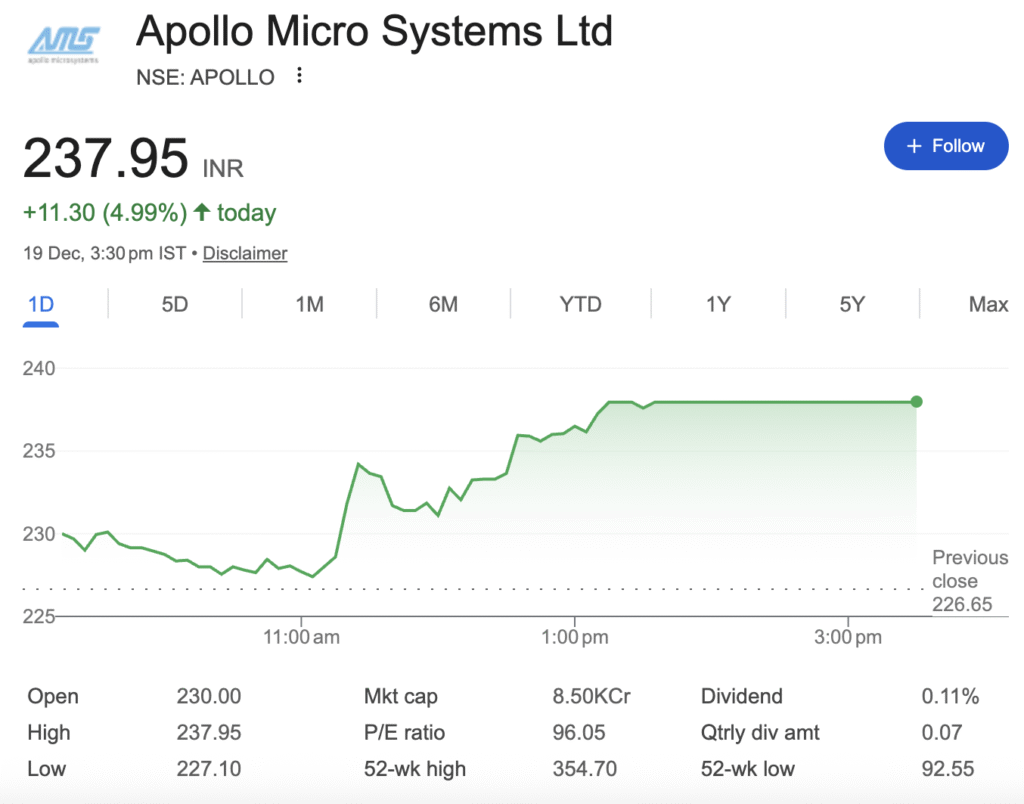
- Current Market Price: ₹237.95 (as of Dec 19, 2025)
- Market Cap: ~₹8,500 Cr
- Valuation Multiples (Based on FY25):
- P/E: 96x (High)
- P/B: ~4.5x
- EV/EBITDA: ~40x
- Peer Comparison: Trades at a significant premium to DPSUs like BEL (P/E ~35x) and even high-growth peers like Data Patterns (P/E ~70x).
- Valuation Justification: The premium is pricing in:
- Monopoly-like position in niche complete weapon systems.
- Exceptionally high growth guidance (45-50% CAGR).
- Strategic scarcity value as a fully integrated private defence OEM.
- Verdict: The stock is undoubtedly expensive on conventional metrics. It is valued as a high-growth, high-optionality story, not on current earnings. Any stumble in execution or growth will lead to severe multiple contractions.
9. Risk Factors
- Business & Execution Risks:
- Working Capital Management Failure: Inability to reduce WC days can lead to perpetual debt raising and equity dilution.
- Project Execution Delays: Defence projects are prone to delays, impacting revenue recognition.
- Integration Risk: Failure to successfully integrate IDL Explosives and realize synergies.
- Financial Risks:
- High Valuation: Biggest risk. Leaves no margin for error.
- Rising Interest Costs: Could pressure margins if debt escalates further.
- Industry & Regulatory Risks:
- Customer Concentration: Heavy dependence on Indian Govt./MoD. Changes in policy or procurement delays can impact business.
- Regulatory Hurdles: Stringent quality and security regulations can slow down production and approvals.
10. Investment Thesis
- Bull Case (Why it Can Outperform):
- AMS executes its order book flawlessly, achieving 50%+ CAGR.
- WC days improve sharply from FY27, leading to strong positive FCF and ROE expansion to 15%+.
- It becomes the go-to private player for complex “Make in India” defence projects, justifying its premium valuation. Stock becomes a multi-bagger.
- Bear Case (What Can Go Wrong):
- Execution delays or cost overruns plague new facilities.
- WC remains stuck >400 days, forcing further debt/equity dilution.
- A slowdown in defence capex or loss of a key program.
- High valuation corrects violently if quarterly growth misses expectations even slightly.
- Key Monitorables for Investors:
- Quarterly Revenue Growth & Order Book Additions.
- Movement in Working Capital Days.
- EBITDA Margin Trend.
- Updates on Unit-III Commissioning and IDL Integration.
11. Final Verdict
- Suitable for: Long-term (5+ years) aggressive investors only. Not suitable for short-term trading, SIP, or conservative investors.
- Investor Profile: Aggressive. Investors must have high risk tolerance, understand the defence business cycle, and be prepared for high volatility.
- Clear Conclusion: Apollo Micro Systems is a fundamentally strong company operating in a stellar structural growth sector. It possesses a wide moat and a visible multi-year growth runway. However, this quality and potential are fully reflected, even overstretched, in its current valuation. The stock is a high-conviction, high-risk bet on flawless execution.
The investment decision hinges entirely on one’s belief in management’s ability to convert its impressive capabilities and order book into sustained earnings and, crucially, into free cash flow over the next 2-3 years. Wait for a margin of safety or evidence of WC improvement before committing fresh capital. Existing holders can stay invested but should be prepared for a bumpy ride.
Disclaimer: “BrightStake” is only an Educational Platform and is not registered under any SEBI Regulations. All Information on this page is for Educational and Entertainment purposes only. Our content does not constitute any Trading or Investment advice. We make no representation of the Timeliness, Accuracy, Profitability, or Suitability of any share on this Website, and we cannot be held liable for any Irregularity or Inaccuracy. Our research is conducted solely for educational purposes, so please utilise our knowledge to inform your investment strategy.