
STL Networks Wins ₹175 Cr Government Contract: What It Means for Share Price and Growth

The company emerges as the lowest bidder (L1) for a major National Informatics Centre project, signaling strong growth prospects in the digital infrastructure space.
Mumbai, February 4, 2026: In a significant development for the telecom and networking sector, STL Networks Ltd (NSE: STLNETWORK) announced on Tuesday that it has emerged as the lowest bidder (L1) and received a Letter of Intent from the National Informatics Centre Services Incorporated (NICSI). The contract, valued at a substantial ₹175 crores (exclusive of taxes), is for the “Procurement of network equipment through NKN” (National Knowledge Network).
This win is a major vote of confidence in STL Networks’ capabilities and positions the company as a key player in India’s expanding digital public infrastructure. The National Knowledge Network is a pivotal government initiative aimed at connecting educational and research institutions across the country with high-speed bandwidth.
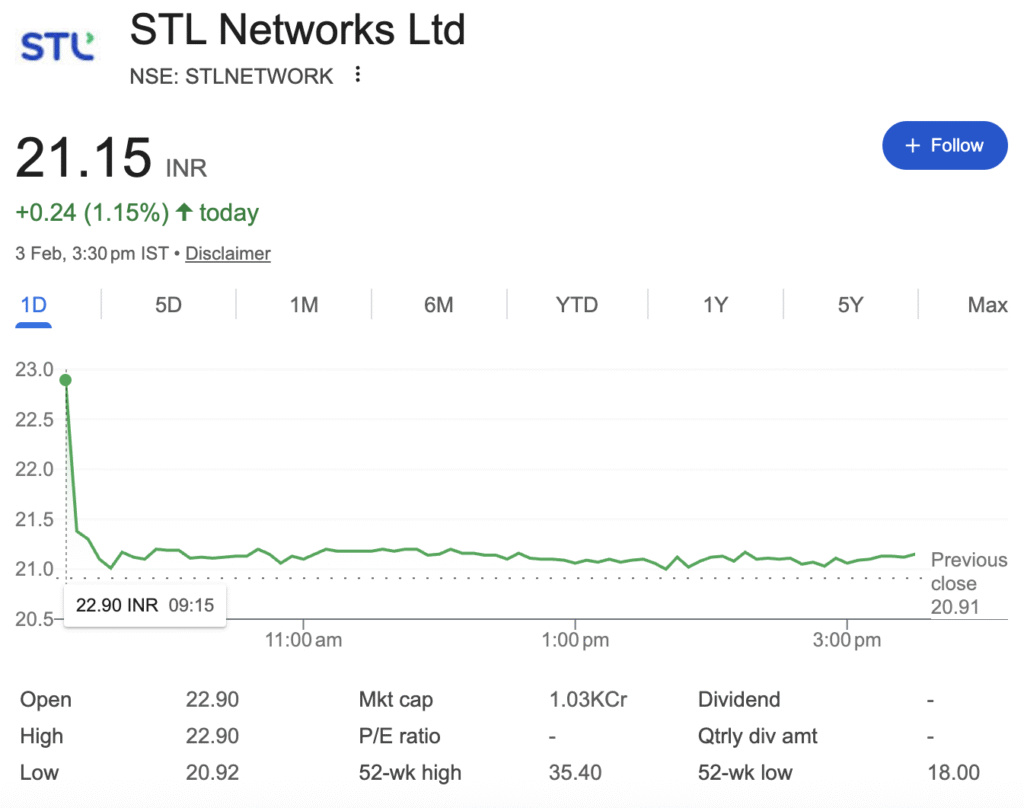
However, this potential stands in stark contrast to its current financial performance, marked by losses and a stock price hovering closer to its 52-week low. This report delves deep into the numbers, the market opportunity, and the execution risks to determine if STL Networks presents a high-risk, high-reward opportunity or a value trap for investors.
Business Overview: A Pure-Play on Digital Services
STL Networks is a pure-play digital services company. Its creation via demerger allowed it to focus exclusively on services, separate from its former parent’s manufacturing operations. The company is headquartered in Gurugram and operates in India and the United Kingdom.
Core Business Segments:
- Cloud Services: Design, migration, and management of cloud infrastructure.
- Cybersecurity: Consulting, security operations, and compliance services.
- Data Center Services: End-to-end design, build, and connectivity solutions for data centers.
- Network & Fibre Services: Deployment of intracity/intercity fibre networks and network operations centers.
Revenue Contribution: While a precise public breakdown for the demerged entity is limited, the parent company, STL, reported that ~23% of its quarterly revenue came from the “Enterprise and Data Centre” segment in Q1 FY26, which aligns closely with STL Networks’ service offerings.
Business Model: STL Networks acts as a system integrator and managed service provider. It wins contracts (projects and recurring services) from clients in telecom, government, BFSI, and healthcare. Revenue is generated through project deployment fees and ongoing management contracts. Its model relies on technical expertise and strategic partnerships with technology firms and hyperscalers to deliver integrated solutions.
Industry & Sector Analysis
- Industry Size & Growth: The digital infrastructure services market in India is experiencing explosive growth, driven by data consumption, 5G rollout, and cloud adoption. The global data center market alone is projected to surpass $300 billion by 2027.
- Key Demand Drivers: (1) Government Capex: Record infrastructure spending of ₹12.2 lakh crore in Budget 2026 fuels demand for digital backbones in rail, smart cities, and rural connectivity. (2) Data Center Boom: A proposed tax holiday for foreign cloud providers using Indian data centers is expected to trigger an investment surge. (3) AI Revolution: AI workloads require dense, high-speed fibre connectivity within and between data centres, creating a new premium demand segment.
- Government Policies: Positive policies like the ‘BharatNet’ project for rural connectivity, the India Semiconductor Mission (ISM 2.0), and the data center tax incentive provide a multi-year visibility pipeline.
- Competitive Intensity (Simplified Porter’s Five Forces):
- Rivalry (High): Competes with large IT firms (TCS, Infosys), telecom operators, and specialised infrastructure players.
- Threat of New Entrants (Moderate): High technical expertise and client relationships act as barriers.
- Bargaining Power of Buyers (High): Large government and enterprise clients can negotiate on price.
- Bargaining Power of Suppliers (Low): Relies on standardised hardware and software.
- Threat of Substitutes (Low): Digital infrastructure is a necessity, not a luxury.
- Industry Cycle Positioning: The industry is in a growth phase, supported by structural, policy-led investments in national digital infrastructure.
Financial Performance Deep Dive (5 Years)
Insight: While long-term trend data for the demerged entity is limited, current metrics reveal a company in financial distress, overshadowing its top-line potential.
Quality of Earnings: Earnings are of poor quality. The negative profit is coupled with negative operating cash flow, indicating earnings are not being converted into usable cash, possibly due to aggressive revenue recognition or poor working capital management.
Margin Contraction Reasons: Low EBITDA margins suggest high operating costs relative to revenue. The journey from a 4.65% EBITDA margin to a -8.96% PAT margin is explained by high depreciation, amortization, and most critically, significant interest expenses on its substantial debt.
Red Flags:
- Consistent Losses & Negative Cash Flow: The most critical red flags.
- High Debt Burden: A Net Debt/EBITDA ratio of 17.7 and interest coverage of just 0.32 signal severe distress in servicing debt.
- Weak Liquidity Generation: Inability to generate cash from core operations.
Balance Sheet & Cash Flow Analysis
- Debt Structure & Repayment Comfort: With total debt of ₹8.27B against cash of ₹0.79B, the net debt is heavy at ₹7.48B. The weak interest coverage (EBIT/Interest = 0.32x) shows very low repayment comfort. The company risks a vicious cycle if earnings don’t improve rapidly.
- Working Capital Cycle: The business model appears to be working capital intensive. Negative operating cash flow implies that money is tied up in receivables or inventory faster than it is collected from customers.
- Capex vs. Cash Generation: Capital expenditures (₹71.3M TTM) are vastly overshadowed by the cash burn from operations (-₹1.13B). The company is investing but is fundamentally funded by debt, not internal cash generation.
- Free Cash Flow Trend: Deeply negative Free Cash Flow of -₹1.05B (TTM). This is unsustainable in the long run.
- Promoter Pledging: No information found in the provided search results regarding promoter share pledging.
Management & Corporate Governance
- Promoter Background & Holding: The promoter is the parent entity, Sterlite Technologies. Post-demerger, the credibility is tied to the parent’s track record in executing large projects.
- Management Commentary Consistency: Recent commentary focuses on innovation (Multi-Core Fibre, AI data centers) and strong order books, which aligns with industry trends. However, the disconnect between optimistic commentary and poor financials is a point of scrutiny.
- Related Party Transactions: As a demerged entity, transactions with the parent group (Sterlite Tech) need close monitoring for fairness.
- Governance Red Flags: A subsidiary, STL UK Ventures, recently lost an adjudication case for non-payment of dues (£83.5k), indicating potential operational or cash flow mismanagement at a local level, though deemed immaterial by the company.
Competitive Positioning & Moat
- Key Competitors: Includes large IT services companies (e.g., TCS, Wipro), telecom infrastructure providers, and specialised firms like RailTel.
- Market Share: Likely a small-to-mid sized player in a fragmented market.
- Pricing Power: Likely low, given competition and the project-based nature of large government/enterprise contracts.
- Entry Barriers: Moderate. Technical expertise and established client relationships in government sectors are key barriers.
- Switching Costs / Brand Strength: Brand strength is regional (“Invenia”). Switching costs for clients are project-specific.
- Scalability: The services business model is theoretically scalable. However, scalability is currently constrained by its weak balance sheet and inability to self-fund growth.
Growth Triggers & Future Outlook (2–3 Years)
- Order Book Execution: The parent STL reported a strong open order book of ₹4,888 Cr. STL Networks’ ability to convert this pipeline profitably is the single biggest near-term trigger.
- Budget 2026 Tailwinds: The massive ₹12.2 lakh crore infrastructure capex and data center tax holiday are powerful, multi-year growth catalysts.
- AI-Led Data Center Portfolio: Expansion into specialised connectivity for AI data centers targets a high-growth niche.
- Margin Levers: Operating leverage from higher revenue and potential cost optimization could improve margins, provided interest costs are managed.
- Long-term Visibility: Government policies like BharatNet provide multi-year visibility, but execution risk remains high.
Valuation Analysis
- Current Multiples: P/E is not meaningful (loss-making). P/B: 1.19x, EV/EBITDA: 40.75x, PS Ratio: 1.16x.
- Peer Comparison & Historical Averages: The search results lack direct peer comparison data for STL Networks. However, a P/B near 1x suggests the market is valuing it close to its accounting book value, not assigning a premium for growth.
- Valuation Justification: The stock is not cheap on a fundamental basis given its losses and high debt. Its valuation primarily reflects option value—the speculative potential that it may capture future growth and return to profitability. The high EV/EBITDA multiple indicates the market capitalisation is low, but the enterprise value is inflated by debt, signaling high risk.
Risk Factors (Very Important)
- Business Risks: Failure to win large projects; intense competition squeezing margins.
- Financial Risks (Most Critical): High debt and interest burden; continued negative cash flow leading to a liquidity crisis; inability to raise further capital if needed.
- Industry Risks: Slowdown in government capex execution; policy changes.
- Regulatory Risks: Compliance with IT and data security regulations.
- Execution Risks: History of subsidiary payment disputes; poor project execution hurting reputation and margins.
Investment Thesis
- Bull Case (Why It Can Outperform): STL Networks successfully leverages government capex and the data center boom, converting its large order book into revenue with improving margins. It manages to refinance or reduce debt, and positive operating cash flow is achieved within 18-24 months. The stock re-rates from a “distressed” to a “recovery” play.
- Bear Case (What Can Go Wrong): The company continues to report losses and cash burn. Rising interest rates further strain its finances. It loses key contracts to competitors or executes them poorly. Debt becomes unserviceable, leading to severe dilution of equity or financial restructuring. The stock price revisits its 52-week low of ₹18.
- Key Monitorables for Investors: (1) Quarterly PAT and Operating Cash Flow trend. (2) Debt reduction and interest coverage ratio. (3) New order wins and execution commentary. (4) Management guidance on path to profitability.
- Clear Conclusion: STL Networks Ltd. is a high-risk proposition operating in a high-growth sector. The disconnect between its promising market position and its troubled finances is stark. An investment here is a bet on a successful operational and financial turnaround. Conservative and moderate investors should avoid this stock until there is clear, sustained evidence of profitability and positive cash flow generation. For the aggressive investor, it represents a speculative bet on India’s digital infrastructure story, where deep due diligence on quarterly financials is non-negotiable.
Disclaimer: “BrightStake” is only an Educational Platform and is not registered under any SEBI Regulations. All Information on this page is for Educational and Entertainment purposes only. Our content does not constitute any Trading or Investment advice. We make no representation of the Timeliness, Accuracy, Profitability, or Suitability of any share on this Website, and we cannot be held liable for any Irregularity or Inaccuracy. Our research is conducted solely for educational purposes, so please utilise our knowledge to inform your investment strategy.