
Bhansali Engineering Polymers: Why a 30% PAT Surge, Zero Debt, and a 33% Capacity Hike Make This ₹100 Stock a Screaming Buy
Despite a modest dip in annual revenue, the specialty chemicals player closed the fourth quarter with EBITDA growth of 33% and a clean 15% PAT margin, while steering a ₹200 crore capacity expansion without taking on debt. Let’s tear down the numbers and see why this could be a textbook deep-value opportunity for patient capital.
Company in Focus: The ABS Specialists
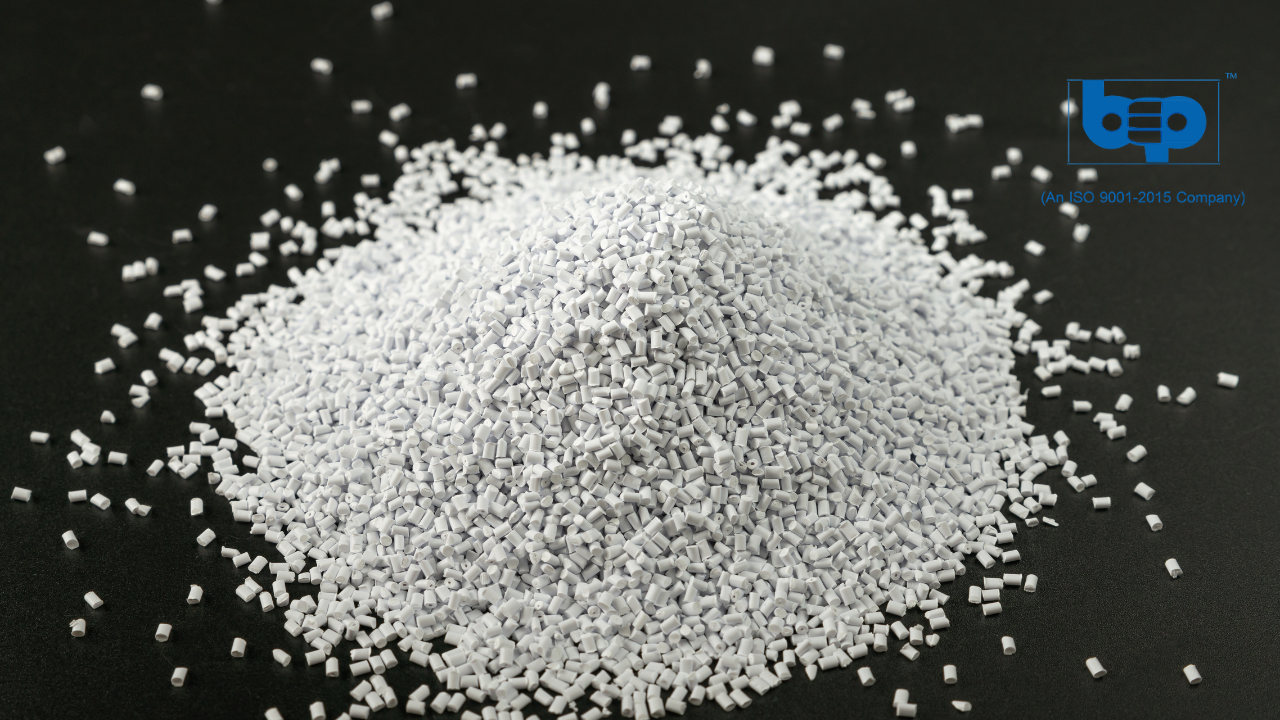
Bhansali Engineering Polymers Ltd (BEPL) is one of India’s leading manufacturers of Acrylonitrile Butadiene Styrene (ABS) and Styrenic resins, having built a strong legacy since 1984. The company operates two state-of-the-art manufacturing facilities — one in Abu Road, Rajasthan, and the other in Satnoor, Madhya Pradesh — with a total installed capacity of 75,000 MTPA. Its diverse product portfolio includes ABS, AES resins, ASA resins, SAN resins, and their thermoplastic alloys with other plastics, catering to industries ranging from automobiles and home appliances to electronics, healthcare, and kitchenware.
Strategic global partnerships have sharpened BEPL’s competitive edge. Its joint venture with Nippon A&L Inc. of Japan, established in 2013, grants the company access to proprietary technologies and high-value speciality polymer formulations, enabling a decisive shift away from commoditised production.
Financial Deep Dive: From Revenue Dip to Margin Surge
For the full year ended March 31, 2026, BEPL reported revenue of ₹1,276.0 crore, reflecting a modest 8.7% year-on-year decline compared to ₹1,397.7 crore in FY25. However, profitability told a different story: EBITDA for FY26 grew by 1.3% to ₹255.2 crore, while EBITDA margin expanded by 200 basis points to 20.0%.
The fourth quarter (Q4 FY26) proved particularly striking:
| Metric | Q4 FY26 | Q4 FY25 | Change |
|---|---|---|---|
| Revenue from operations | ₹341.6 Cr | ₹344.9 Cr | -1.0% |
| EBITDA | ₹74.3 Cr | ₹55.8 Cr | +33.1% |
| EBITDA Margin | 21.8% | 15.8% | +600 bps |
| PAT | ₹51.6 Cr | ₹39.5 Cr | +30.6% |
| PAT Margin | 15.1% | 11.5% | +360 bps |
Thus, while top-line growth remained tepid, BEPL’s sharp operating leverage and cost discipline drove a notable improvement in profitability.
Five‑Year Financial Snapshot (₹ Crores):
| Particulars | FY22 | FY23 | FY24 | FY25 | FY26 |
|---|---|---|---|---|---|
| Revenue from operations | 1,394.0 | 1,362.6 | 1,221.7 | 1,397.7 | 1,276.0 |
| EBITDA | 482.2 | 205.9 | 251.5 | 251.9 | 255.2 |
| EBITDA Margin (%) | 34.6% | 15.1% | 20.6% | 18.0% | 20.0% |
| PAT | 350.0 | 136.7 | 179.4 | 180.0 | 180.2 |
| PAT Margin (%) | 25.1% | 10.0% | 14.7% | 12.9% | 14.1% |
| EPS (₹) | 14.04 | 5.46 | 7.22 | 7.23 | 7.25 |
Source: Screener.in (standalone financials)
The sharp margin recovery from the depressed levels of FY23 — when crude oil volatility hammered the entire petrochemical chain — underscores BEPL’s operational resilience. From 15.1% in FY23, EBITDA margins have now stabilised in the 18%–21% range.
Key Ratios: A Zero‑Debt Profile
| Ratio | FY24 | FY25 | FY26 |
|---|---|---|---|
| Return on Capital Employed (ROCE) | 24% | 25% | 24% |
| Return on Equity (ROE) | 18% | 17% | 17% |
| Debt-to-Equity | 0.00 | 0.00 | 0.00 |
| Dividend Yield* | — | — | ~4.0% |
*Based on the current market price of approx. ₹100
The ₹200 Crore Catalyst: Capacity Expansion to 100 KTPA
The most significant near-term catalyst for Bhansali Engineering Polymers is its ongoing capacity expansion. The company is investing ₹200 crore to debottleneck its existing facilities, raising installed capacity from 75,000 MTPA to 100,000 MTPA.
This expansion is fully funded through internal accruals, meaning it will not add any debt or equity dilution to the balance sheet. Commissioning is scheduled for September 2026, with optimal utilisation expected by the end of FY28. At full utilisation, this expansion could potentially increase revenue capacity by approximately 33% from current levels, while also improving operating leverage as fixed costs are spread across higher volumes.
Growth Drivers & Industry Tailwinds
Application Diversification: BEPL serves a wide range of end-user industries, from automotive (both two‑wheelers and four‑wheelers) to consumer durables, electronics, healthcare, kitchenware, and electrical appliances. This diversification helps the company navigate cyclical downturns in any single segment.
Shift to Specialty Polymers: Through its joint venture with Nippon A&L Inc. (Japan), BEPL has moved beyond commoditised ABS into high-value speciality compounds, including ASA (Acrylonitrile Styrene Acrylate) for weather-resistant applications and PC-ABS blends for flame-retardant, high-heat environments. The R&D pipeline remains active, with new grades continuously being developed.
Capacity Utilisation: The upcoming 100 KTPA capacity will allow BEPL to capture a larger share of India’s growing engineering plastics market, which is experiencing rising demand from automotive lightweighting, electric vehicle adoption, and the Make in India push.
Strategic Joint Venture: The 2013 JV with Nippon A&L Inc. has been a cornerstone of BEPL’s technological edge. It provides access to proprietary formulations, colour technology, and global quality benchmarks, creating high entry barriers for new competitors.
Risks & Challenges
Raw Material Volatility: ABS is a petroleum-derived product. Input costs are directly tied to crude oil and styrene monomer prices. A sustained surge in crude oil prices could compress margins, despite the company’s low-cost producer status.
Cyclical Demand: Demand for ABS and engineering plastics is linked to industrial capex cycles, especially in automotive and consumer durables. An economic slowdown could affect volume offtake.
Import Competition: Chinese and Southeast Asian ABS producers have historically dumped material into Indian markets. BEPL’s BIS certification (IS 17077) provides some regulatory protection, but pricing pressure from international players remains a persistent risk.
Capacity Execution Risk: Delays in commissioning the expanded capacity beyond the September 2026 target could defer expected revenue and margin benefits.
Recent News & Management Commentary
In its investor presentation for the quarter ended March 31, 2026, management provided the following updates:
- Capex Timeline: The ₹200 crore expansion remains on track, with commissioning targeted for September 2026.
- Funding Source: The capex is fully funded through internal accruals, reflecting the company’s strong free cash flow generation and zero-debt philosophy.
- Demand Outlook: Optimal utilisation of the expanded capacity is expected by the end of FY28, suggesting a measured ramp-up.
- Dividend: The board has recommended a final dividend of ₹1.00 per share (face value ₹1.00) for FY26, payable on or before July 31, 2026, subject to shareholder approval.
Valuation & Industry Positioning
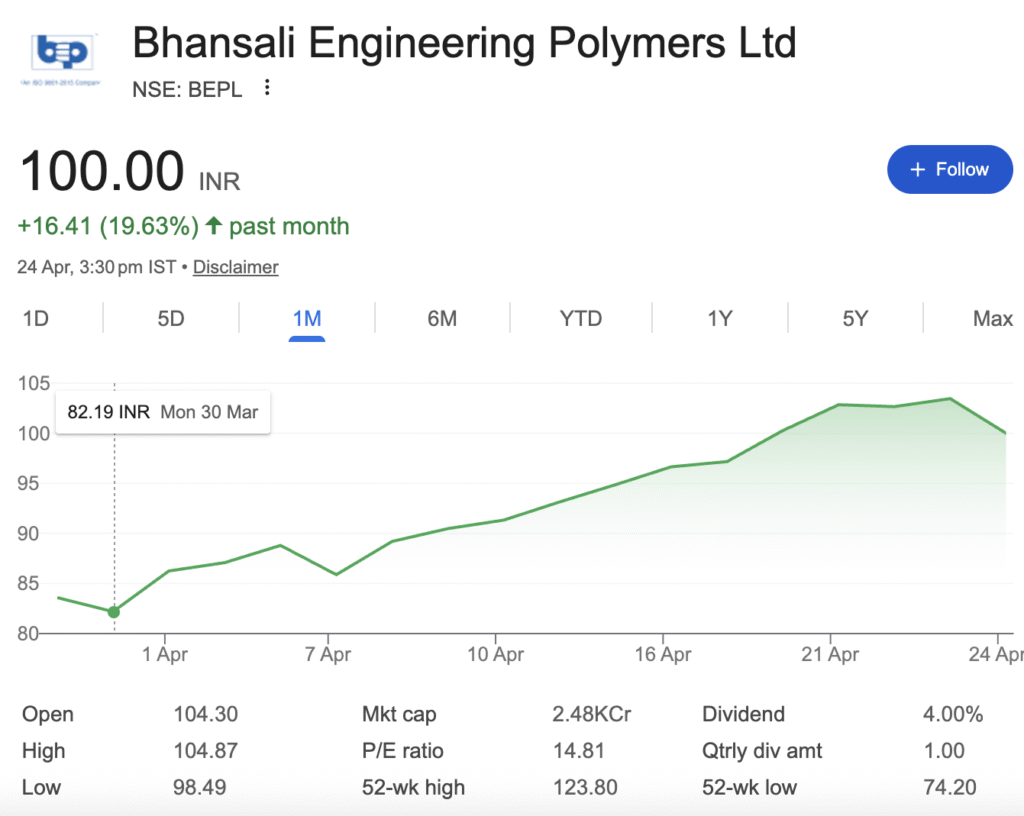
With a current market price of approximately ₹99.6, Bhansali Engineering Polymers commands a market capitalisation of about ₹2,478 crore. Its trailing P/E of 13.7x sits significantly below the mid-cap speciality chemical sector average, which often trades in the 20x–25x range.
| Metric | BEPL | Peer Context |
|---|---|---|
| P/E Ratio | 13.7x | Below industry average |
| P/B Ratio | ~2.3x | Conservative valuation |
| Dividend Yield | ~4.0% | Above sector median |
| ROCE | 23.8% | Among top quartile |
| ROE | 17.3% | Healthy but moderate |
On the one hand, this valuation discount could reflect the company’s modest top-line growth in recent years; on the other hand, it may also represent an opportunity if the upcoming capacity expansion achieves its potential.
The Outlook: A Story of Cautious Optimism
Bhansali Engineering Polymers stands at a critical juncture. The company has successfully navigated the volatile petrochemical environment of recent years, emerging with a zero-debt balance sheet, healthy profitability, and a clear growth roadmap. The upcoming capacity expansion, funded entirely through internal accruals, offers a visible path to revenue and earnings growth, provided demand conditions remain supportive.
However, investors should also consider the challenges: subdued top-line growth, raw material price volatility, and import competition remain ongoing concerns. Additionally, the September 2026 commissioning date is still several months away, and the full benefits of the expansion will only materialise over the following 18–24 months.
Ultimately, Bhansali Engineering Polymers presents a narrative of disciplined capital allocation, operational efficiency, and niche technological expertise — qualities that have helped it maintain consistent profitability even in difficult times. Whether the upcoming capacity expansion can translate into sustained growth will depend largely on the broader industrial environment and the company’s ability to continue shifting its mix toward higher-margin speciality polymers.
Disclaimer: “BrightStake” is only an Educational Platform and is not registered under any SEBI Regulations. All Information on this page is for Educational and Entertainment purposes only. Our content does not constitute any Trading or Investment advice. We make no representation of the Timeliness, Accuracy, Profitability, or Suitability of any share on this Website, and we cannot be held liable for any Irregularity or Inaccuracy. Investors are advised to conduct their own independent research and consult with a qualified financial advisor before making any investment decisions.